
Over the decades there has been much written about developing the Moon, creating a permanent human presence on the Moon, and turning the Moon into a resource for the continued development of human civilization. I have no doubt that those who wrote with enthusiasm on this subject in the 60’s and 70’s would be shocked to see that 50 years later we have made no tangible progress. However, technological advances over the last 50 years have made lunar development more feasible.
In consideration of these advances, it would be useful to identify the top ten challenges to the successful economic development of the Moon. These challenges can be broadly categorized into the challenges of dealing with the Moon’s extreme environmental conditions, dealing with the lack of mature technologies for lunar operations, and dealing with the economic challenges associated with establishing business ventures on the Moon. The ten individual challenges listed here are not in any specific order and no attempt is made to rank them from most to least challenging.
Beginning with the environmental challenges that are inherent to operating on the Moon, for this list the key lunar environmental challenges are:
The Lunar Radiation Environment
Thermal Extremes and Lunar Nights
Abrasive, Electrostatically Charged Lunar Dust
This is not to say that these are the only challenges of the lunar environment. Other challenges include the Moon’s gravity, the vacuum, and the nature of the lunar resources profile. But these challenges can be seen as being highly predictable constants.
The second category of challenges are those associated with the relevant supporting technologies. While much technological development with respect to life support, thermal management, and power management has been accomplished in the context of the International Space Station, there is an area of technology development that is critical to lunar operations. These technologies are:
In-Situ Resource Utilization (ISRU) Technologies
Yes, there is one singular area of technology development that is central to the successful establishment of economic activity on the Moon and that is those technologies associated with mining and refining the Moon’s resources.
The final set of challenges are those that have a direct and immediate financial impact on any business operating on the Moon. These challenges can be characterized as:
Transportation Costs
Forced Vertical Integration
Ambiguous Legal Frameworks and Property Rights
Unproven Markets
Lack of Interoperability and Standardization
Financial Risks and Insurance
Over the course of this article, each of these challenges will be addressed in turn. Again, this list of the top ten development challenges are not ordered by degree of difficulty. No attempt is made to, for example, determine whether dealing with the radiation environment is of greater or lesser difficulty than the forced vertical integration challenge.
The Challenges of the Lunar Environment
A key aspect of building a permanent human presence on the Moon is successfully overcoming the environmental challenges that the lunar environment presents to both life and machines. The challenge of the Moon’s not having an atmosphere is not considered here as that is a challenge that has been overcome in the past, albeit on a much smaller scale. And it can be considered to be an unchanging constant.
Environmental Challenge: The Lunar Radiation Environment
Without the presence of a thick atmosphere and a magnetic field, such as Earth has, the surface of the Moon has no protection from cosmic and solar radiation. The solar radiation is in the form of Solar Energetic Particle (SEP) events which are episodic in nature and highly unpredictable in strength. Cosmic radiation is in the form of Galactic Cosmic Rays (GCR) which are continuous.
For comparison, the average radiation dose on the surface of the Earth is 0.0036 Sieverts per year (Sv/yr) while on the lunar surface, the average dose is 0.25 Sv/yr. More importantly, a single severe solar flare, which spawns a Solar Energetic Particle (SEP) event, can deliver a dose of up to 1,000 Sv in a matter of hours, which is lethal. For humans, exposure to these levels of radiation can cause acute radiation syndrome, central nervous system damage, severe gastrointestinal issues, DNA breaks that drastically increase the lifetime risk of cancer, or even death in the event of a major SEP event. This radiation doesn’t impact just humans. It impacts all living biology and our electronics.
For biology, protection is provided in basically one form: minimizing exposure. In the case of an astronaut working on the surface of the Moon, this means limits to how long the astronaut can stay outside, as well as not venturing outside when a SEP event is in progress. In all other cases, protection comes in the form of shielding, accomplished using raw mass. Providing sufficient radiation protection (shielding) for both man and machine fundamentally dictates the architecture of lunar bases in terms of design based on radiation protection. Whether built above ground, or below the surface, providing the necessary degree of radiation protection greatly increases the cost of operations on the Moon because of the amount of mass involved. Radiation protection that is approximately equal to that provided by the Earth’s natural environment would require that a surface habitat be covered by up to 5.4 meters of lunar regolith per square meter.
Environmental Challenge: Thermal Extremes and Lunar Nights
The Moon has a temperature environment that is quite extreme, ranging from 127°C (260°F) when in direct sunlight to as low as -173°C (-280°F) during the lunar night. Even worse is the cold experienced inside the permanently shadowed craters at the lunar poles, a place we want to operate given the presence of water ice. Estimates are that the temperatures there can drop to as low as -250°C (-410°F). This large temperature range from hot to cold puts sever thermal strains on equipment and structures – which must be addressed. The design challenges are even more extreme for equipment operating ‘outside’ as thermal management systems have to be built into any system that is exposed to the bitter cold of the lunar night.
The problem with the ‘dark of the Moon’ temperatures is compounded by the length of the lunar night. Once the Sun has set, you are looking at a nighttime that lasts almost 15 Earth days (more precisely, 14.77 Earth days). To survive these long cold nights, equipment will need to be kept heated – which will require heavy duty thermal management systems and significant amounts of stored energy (battery power) to power them. And what will be the power source that keeps everything warm and running during the lunar night? If the answer is solar power, then understand that solar arrays will need to be massively overbuilt in order to not only provide for daytime energy demands but to then generate sufficient energy to charge the massive arrays of batteries that will need to provide the energy needed through the long lunar night.
Environmental Challenge: Abrasive, Electrostatically Charged Lunar Dust
Unlike the Earth, the Moon lacks the wind and water that over time naturally smoothes the surfaces of stones, pebbles, grains of sand, etc. On the Moon, weathering is accomplished by impact, resulting in fine, sharp, and highly abrasive surfaces. Further, the lunar dust’s exposure to the solar terminator and ultraviolet radiation strips electrons from the dust, imparting a strong electrostatic charge that causes the particles to levitate above the surface and aggressively adhere to almost any material they touch, including spacesuits, skin, and metal equipment. Consequently, this highly abrasive dust will be everywhere: degrading mechanical joints, destroying seals, and abrading optical sensors.
In addition to the threat to equipment, lunar dust poses a serious threat to human health. If lunar dust makes its way into a lunar habitat and is subsequently inhaled, it can pose severe respiratory and cardiovascular risks. It remains to be seen how effective, and costly, design countermeasures will be in protecting both man and machine from the multiple threats posed by lunar dust.
The Lunar Technologies Challenges
As humanity has never had a sustained operational presence on the Moon, we have the challenge of both developing and adapting a range of technologies for sustained operations in the lunar environment. When it comes to evaluating the maturity of a technology, there is the concept of the Technology Readiness Level (TRL). The TRL concept is most useful for gauging the degree of risk in using a particular technology to solve a problem and in comparing different technologies when more than one can be used in a design solution. Table 1 below provides a summary of the individual Technology Readiness Levels.
| Overall Class | TRL Number | Description |
|---|---|---|
| Research and Proof of Concept | TRL 1 | Basic principles observed and reported. |
| TRL 2 | Technology concept and/or application formulated. | |
| TRL 3 | Analytical and experimental critical function and/or characteristic proof of concept. | |
| Component and Breadboard Testing | TRL 4 | Component and/or breadboard validation in laboratory environment. |
| TRL 5 | Component and/or breadboard validation in relevant environment. | |
| TRL 6 | System/subsystem model or prototype demonstration in a relevant environment. | |
| System Demonstration and Operation | TRL 7 | System prototype demonstration in an operational environment. |
| TRL 8 | Actual system completed and qualified through test and demonstration. | |
| TRL 9 | Actual system proven through successful mission operations. |
Another aspect of the technology challenges that must be considered is that of the manufacturing challenges. To address this, we can use the Manufacturing Readiness Level (MRL) concept, which is a metric used to assess the maturity of a technologies used in manufacturing processes. Table 2 provides an overview of the Manufacturing Readiness Levels.
| Overall Class | MRL Number | Description |
|---|---|---|
| Basic Manufacturing Implications and Concepts | MRL 1 | Basic Manufacturing Implications Identified. |
| MRL 2 | Manufacturing Concepts Identified. | |
| MRL 3 | Manufacturing Proof of Concept Developed. | |
| Laboratory and Prototyping Environments | MRL 4 | Capability to produce the technology in a laboratory environment. |
| MRL 5 | Capability to produce prototype components in a production-relevant environment. | |
| MRL 6 | Capability to produce a prototype system or subsystem in a production-relevant environment. | |
| Production Demonstration and Initial Rate Production | MRL 7 | Capability to produce systems, subsystems, or components in a production-representative environment. |
| MRL 8 | Pilot line capability demonstrated; Ready to begin Low Rate Initial Production (LRIP). | |
| MRL 9 | Low rate production demonstrated; Capability in place to begin Full Rate Production (FRP). | |
| Full Rate Production | MRL 10 | Full Rate Production demonstrated and lean production practices in place. |
Following is the list of the major technology challenges associated with developing viable and sustainable commercial activities on the Moon.
Technology Challenge: In-Situ Resource Utilization (ISRU) Technologies
To become economically sustainable, the lunar economy must quickly learn how to “live off the land” by extracting water, oxygen, metals, and other materials from the lunar regolith – thus minimizing the costs of importing mass from Earth while providing a soure of raw materials to be used as inputs to lunar construction and manufacturing processes. To continue to develop, the lunar economy must also learn how to produce goods for export to other systems – be they space-based or Earth-bound.
However, these ISRU capabilities are currently at a low Technology Readiness Level (TRL) and what is essentially a non-existent Manufacturing Readiness Level (MRL). We have never conducted mining operations in anything at all like the lunar environment, nor have we ever attempted manufacturing in that environment. Operating complex chemical processing and molten regolith electrolysis plants in the Moon’s 1/6th gravity environment, which alters fundamental fluid dynamics, presents a major challenge. Further complicating the process is that the manufacture of a single product on the Moon will consist of employing multiple technologies that must be assembled together into a single manufacturing stream. In short, lunar mining, refining, chemical processing, and manufacturing collectively face massive engineering – and experiential – hurdles.
The Business Challenges
The challenges identified in the environmental and technological sections of this top ten list are also business challenges in that they have a direct impact on capital expenditures, operating costs, and risk.
The following challenges focus more directly on the ability of a business to successfully undertake operations on the Moon and make a profit in the process. To be clear, profit is the flag that tells the world that the value of the product being created is greater than the value of the goods and services used to create that product and should be viewed as one of the key metrics for sustainable operations. Linked to the ability to price goods so as to make a profit is the related challenge of being able to sell that product at a price which creates and sustains a market demand for said product.
Following is the list of the key challenges businesses will face in their attempts to successfully undertake commercial projects on the Moon.
Business Challenge: Transportation Costs
In a 2007 BBC Documentary titled ‘Mining The Moon for Helium-3’, University of Wisconsin Professor Jerry Kulcinski stated: “If we had gold bricks stacked up on the surface of the Moon, we couldn’t afford to bring them back… There is nothing that we know of in the solar system that is worthwhile going out to get to bring back to the Earth.“
At the time that documentary was made, gold was selling for approximately $10,000 a pound or $22,046 a kilogram. The implication of this statement was that a mission from the Earth to the Moon to simply pick up gold bars and return them to Earth could not be done for less than $22,046 a kilogram.
Translating that into the price of a product more easily understood, an equivalent statement would be that “If you had barrels of oil stacked up on the Moon, and the price of gasoline was $153,000 dollars a gallon, you would lose money going to the Moon to get that oil!” That’s the bad news but the actual news is much worse. To achieve round trip mission costs of $22,046 a kilogram would be far more revolutionary than SpaceX’s achievement of lowering launch costs to LEO through fully reusable rockets. Estimates for making a journey to the lunar surface and returning from there, with payload, to the Earth’s surface are on the order of some millions of dollars per kilogram. Let us be optimists and say that we can get the round trip mission price down to $1,000,000 per kilogram. Returning to the gasoline analogy, with round trip transportation cost of $1,000,000 per kilogram, the market price for gasoline would need to be $6,940,034 a gallon to cover the Earth to Moon to Earth transportation costs.
Clearly, the cost of transporting goods to the surface of the Moon will represent a major capital expenditure, hence the criticality of developing ISRU and associated technologies. Similarly, the cost of transporting products from the Moon back to the Earth will require the development of novel transportation technologies.
Business Challenge: Forced Vertical Integration
At this time, any business that wants to establish commercial operations on the Moon will have to provide all of the infrastructure that it needs to carry out its operations. The infrastructure components can be characterized as follows:
Transportation and logistics systems
Power generation, management, storage, and distribution
Thermal management systems
Communications and Positioning, Navigation, and Timing (PNT) systems
Environmental Control and Life Support Systems (ECLSS)
ISRU and manufacturing systems
That a commercial entity must address all of these infrastructure issues represents a case of vertical integration taken to the extreme – vertical integration being a business model wherein a business controls multiple stages of the production and/or distribution process. The need for a business operating on the Moon to have complete vertical integration as a business model adds substantially to capital expenditures (CapEx), operating expenses (OpEx), system complexity, operational risk, and Time to Market (TTM).
Business Challenge: Ambiguous Legal Frameworks and Property Rights
The legal framework that is currently in place for lunar operations, primarily though the Treaty on Principles Governing the Activities of States in the Exploration and Use of Outer Space, including the Moon and Other Celestial Bodies(www.unoosa.org/oosa/en/ourwork/spacelaw/treaties/introouterspacetreaty.html) was designed on the assumption that all space activities would be conducted by governments. No thought was given at the time to the potential for future private or commercial space development.
A particular sticking point is that of property rights, which is a crucial element for successful economic development. A relevant definition of ownership as applied to the ownership of property is that of John Locke, widely regarded as one of the most influential of the Enlightenment thinkers and commonly known as the “father of liberalism”. In his The Two Treatises of Civil Government, Locke wrote that:
Thus the… ore I have digged in any place, where I have a right to them in common with others, become my property, without the assignation or consent of any body. The labour that was mine, removing them out of that common state they were in, hath fixed my property in them. The great and chief end, therefore, of men’s uniting into common-wealths, and putting themselves under government, is the preservation of their property.
Clear, unambiguous, and legally enforceable acquisition and transfer of property rights by entities engaged in development operations on the surface of the Moon will be crucial to attracting businesses and investment. Indisputable title to said property means that land can be counted by a business as being an asset and can be used as reliable collateral for loans.
While the question of property rights is a central legal issue, it is not the only issue. Other legal issues include those of liability, authorizations, contractual relationships, and dispute resolutions. The challenges of an ambiguous legal framework is further cross-linked with the insurance premiums challenge with respect to issues of liability.
Business Challenge: Unproven Markets
For a business to be successful, there must be a fairly well understood market for the product being produced and that market must be of sufficient size to support the business’ ongoing operations while also providing an acceptable return on investment (ROI). At this time, predictions of demand for lunar goods is very theoretical and speculative, which translates into risk. It may well be expected that for some years, the bulk of the demand for any commercial products produced on the Moon will come from government space agencies. Consequently, government agencies will be the “anchor customers” which subjects their revenue to a not very predictable cycle of politically motivated budgets. While government monopsonies can, and most certainly will, play a crucial role in the initial creation of markets for lunar goods and services, that dependency needs to be phased out as rapidly as possible.
Business Challenge: Lack of Interoperability and Standardization
The interoperability and standardization challenge is without doubt the easiest of the challenges on this list to overcome. The need for standardized, interoperable systems with universal hardware interfaces is inextricably linked to the vertical integration challenge for without the ability for systems to ‘talk’ to one another, each entity will in essence be its own island on the Moon. Here, the challenge is not native to operating on the Moon but rather a determination of the process by which interoperability standards can be defined, developed, and deployed across multiple commercial entities and governments.
Business Challenge: Financial Risks and Insurance
Consider the financial challenges that a business that wants to build a factory on the Moon will experience. First there are the large capital expenditures required to build a ‘factory’ on the Moon – a thoroughly novel undertaking. This is compounded by the high technological risk accompanying the operation, which translates directly into financial risk. Then there is the amount of lead time needed before actual product production can begin, again a case of increasing amounts of time required which equates to increased levels of risk. This combination of financial challenges and risk makes it highly unlikely that the business will be able to attract the capital investments that it will need to move ahead.
There is also the challenge, and the premium cost, of insuring an enterprise operating in the legal ‘Wild West’ that is the Moon. Normally, insurance companies rely on historical data as a key element in establishing insurance premium rates. But what if there is no historical data? Given the completely novel nature of a business operating on the Moon, and the immature Technology Readiness Levels and Manufacturing Readiness Levels, as well as the array of other unknowns associated with prolonged operational activities on the Moon, insurance premiums can be expected to account for a substantial fraction of the business’ operating costs. While the International Space Station was largely self-insured by the various sovereign governments involved in the project, it remains to be seen what degree of insurance risk, if any, will be accepted by those governments who have commercial entities involved in operations on the Moon.
Summary of the Top Ten Challenges
The ten challenges identified here are drawn from three problem domains: the natural environment domain, the technological domain, and the economic domain. The ten challenges identified are:
- Environmental: The Lunar Radiation Environment
- Environmental: Thermal Extremes and Lunar Nights
- Environmental: Abrasive, Electrostatically Charged Lunar Dust
- Technology: In-Situ Resource Utilization (ISRU) Technologies
- Business: Transportation Costs
- Business: Forced Vertical Integration
- Business: Ambiguous Legal Frameworks and Property Rights
- Business: Unproven Markets
- Business: Lack of Interoperability and Standardization
- Business: Insurance Premiums and Financial Risks
Collectively, the individual challenges identified within these three domains represent the spectrum of problems that commercial operations will have to address in order to be sustainable. No attempt has been made to rank these ten specific challenges due to the degree of uncertainty associated with the quantification of each challenge. Nor have biological considerations beyond those of radiation exposure and lunar dust exposure been included as the potential exists for fully automated operations that may or may not require some intermittent human presence.
Novel approaches to combinations of individual challenges could significantly alter the situation. For example, fully automated systems would lower the hurdle for multiple challenges simultaneously. Deployment of a system of efficient mass drivers could significantly impact the Moon to Earth transportation costs. A Lunar Platform as a Service (PaaS) model could address the Vertical Integration challenge. A combination of ingenuity, innovation, and flexibility could make it possible to bridge the chasm between where we are now and where we need to be in order to succeed at establishing commercial operations on the Moon.
This list of development challenges clearly shows that establishing thriving permanent human settlements on the Moon will not be an easy task. But, paraphrasing President John Kennedy, we do these things not because they are easy but because they are hard. How easy or hard it will be to overcome any of these challenges will depend on our degree of ingenuity and ability to develop innovative solutions.
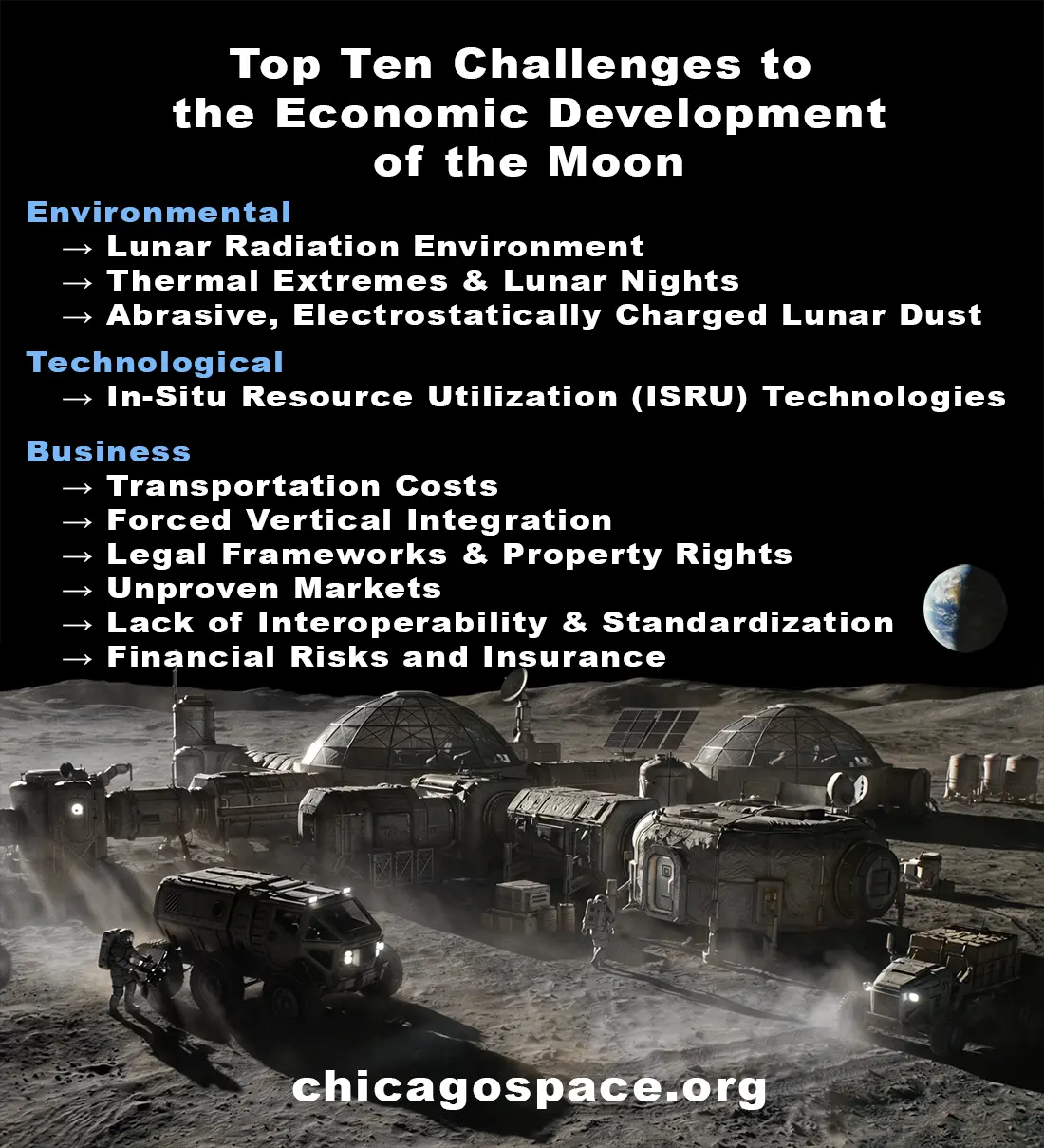
The Top Ten Challenges to the Economic Development of the Moon Infographic