
By William Halal. First published as “The Coming Space Age: Forecasts from the TechCast Project,” in Angus Hooke (ed), Technological Breakthroughs and Future Business Opportunities in Education, Health, and Outer Space (IGI Global, 2021). [The volatile nature of the space sector makes predictions particularly challenging. For an example of another set of predictions, see Dylan Taylor Makes Seven Predictions About Future Space Developments at ISDC from 2023. The Editor.]
ABSTRACT
This chapter draws on forecasts from The TechCast Project to map out the beginning of the Space Age about 2050. The author’s work on the Life Cycle of Evolution shows that the world is moving beyond the Knowledge Age, which began about AD 2000, and is now entering an Age of Consciousness about 2020. This seems to mark the culmination of civilization on Earth, when the planet reaches a stage of maturity needed to resolve historic threats such as climate change. If this passage to a unified global order is successful, it should mark the beginning of space exploration beyond the solar system. The commercialization of space will likely be well underway, and colonies established on the Moon and possibly Mars, solar satellites will likely be functioning, and space tourism will become normal. With Earth a stable civilization, attention should then turn to this final frontier of space. The intellectual resources of roughly 10 billion educated people will be drawn on to make the breakthroughs in our understanding of physics needed to travel to star systems.
The idea of commercial space tourism seemed silly at first. But when Dennis Tito traveled into space as a private astronaut in 2001, it soon became clear that more would follow. Now, commercial ventures are flying to near-Earth orbit, and many are planning space hotels, tours to lunar orbit and expeditions around the Moon. Driven by our need to explore, we are about to leave our planet en masse. Peter Diamandis said, “We’re on the verge of the golden age in space. It should soon be possible to tour space on a routine basis.” (Diamandis, 2020).
This article draws on the foresight research conducted by The TechCast Project to chart the path into a Space Age. TechCast draws on a state-of-the-art collective intelligence system to produce some of the most authoritative forecasts available. Results suggest the commercialization of space is poised to reach the critical take-off point in the next several years, about 2025 +/- 3 years, growing into a $1 trillion industry that promises to transform our world. A Moon colony should be established in about 15 years, solar satellites are likely to power earth systems about the same time, and humans are likely to land on Mars a bit later, roughly 2040. Travel to neighboring star systems is suggested to occur about 2050, and first contact with alien civilizations in roughly 2060 or so.
However, the theoretical model guiding this research suggests this will require a higher level of global consciousness able to support a Space Age. Drawing on a theory describing the Life Cycle of Evolution, we see that the existential transition to space is only possible if the world is able to resolve the constellation of crises (climate change, etc.) that threaten civilization itself.
Evidence shows the world is now moving beyond the Knowledge Age into an Age of Consciousness and reach global maturity (Halal, forthcoming). If this can be done, the world should become almost fully industrialized, well-educated and integrated into a sustainable global order about 2050. Automation and artificial intelligence will eliminate routine knowledge work, turning resources and attention to the exploration of deep space.
The seven forecasts that follow outline our push into this final frontier. They are only rough estimates, of course, with accuracy of plus or minus roughly five years. But they capture the timing and broad themes likely to mark this historic passage.
Theoretical Framework: The Life Cycle of Evolution
The opening of a Space Age can be best understood as a historic shift in social evolution. This is illustrated by the graph shown in Figure 1 below. I have struggled with this problem for years, and the result is this trendline showing what I call the “Life Cycle of Evolution (LCE).” Similar graphs have been sketched in general terms, but this is the first to plot the long-term evolutionary trend using real scales and real data (Halal, 2004). The logarithmic time scale is needed to encompass the billions of years at the start of life, as well as mere decades today. Without a log scale, the shape of the LCE would not be recognizable; the trendline would run flat and make a sharp 90 degree turn straight up.
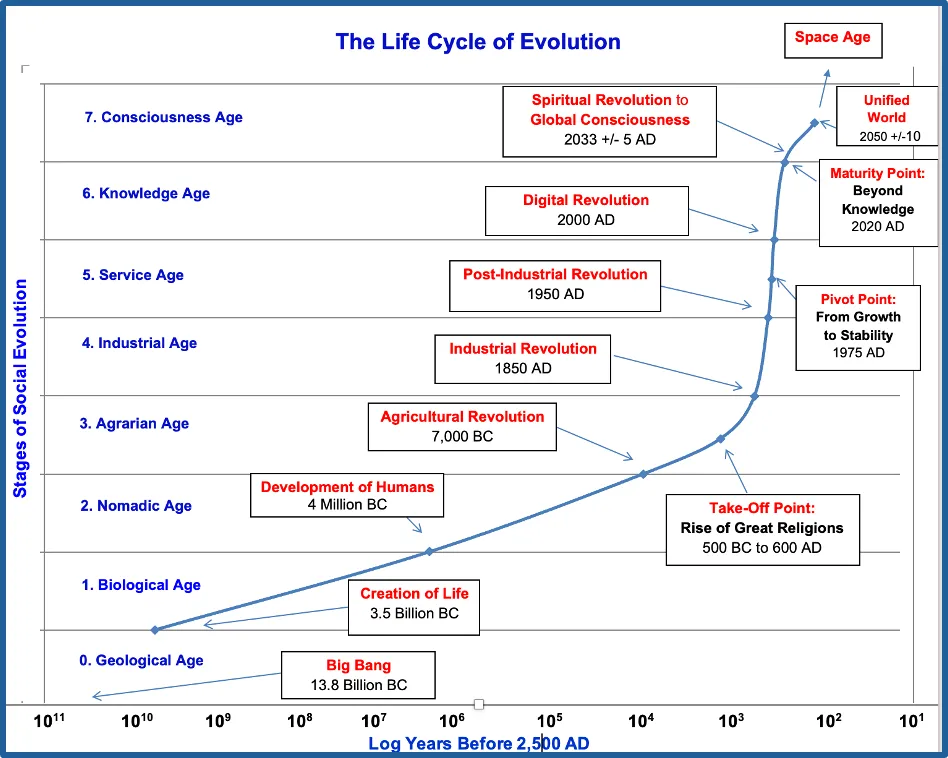
Figure 1: The Life Cycle of Evolution
Above the fray, there is a rather precise direction and logic to this evolutionary process. Four million years of nomadic human development were needed to found Agrarian Civilizations. Eight thousand years to invent Industrial Society. Two hundred years for the Post-Industrial Economy. Five decades to a Knowledge Age. And roughly 20 years to an Age of Consciousness that is starting today about 2020. The completion of this mature phase in the LCE could then lead to the serious start of a Space Age about 2050.
Beneath this tectonic shift in consciousness is the driving force of artificial intelligence (AI), the most powerful agent of change today. Sundar Pichai, CEO of Google, said “AI is probably the most important thing humanity has ever worked on … more profound than fire or electricity.” The advance of AI is automating knowledge work, threatening to eliminate roughly half of all jobs and posing one of the most perplexing questions of our time: What lies beyond knowledge?
It follows logically that everything beyond knowledge is consciousness. Civilization is at the cusp of transformation from a society based on knowledge to one guided by consciousness. The great Jesuit anthropologist, Pierre Teilhard de Chardin, has long fascinated us with his vision that the world would evolve into a “noosphere,” a great web of consciousness enveloping the Earth (de Chardin, 1955).
Not too long ago, we relied on telephones and newspapers to communicate. We now use two billion personal computers, 14 billion cell phones and laptops, and two billion TVs. The information flows through 30 million Internet servers, 3,000 space satellites and almost one million miles of undersea cables. Kevin Kelly, founder of Wired magazine, thinks the Internet is subsuming the knowledge of all humans into a “global central nervous system.” He observed, “There is only one time in the history of each planet when its inhabitants first wire up its innumerable parts to make one large machine.” (Kelly, 2016). This planetary layer of digital connections knits eight billion people into a living overlay of thought – the noosphere is here.
This historic transition also poses enormous threats that seem almost impossible. Climate change and the entire constellation of end-of-the-world challenges comprise what I call the “Global MegaCrisis,” or the “Crisis of Global Maturity.” A survey I conducted estimates that roughly 70 percent of the public thinks the present world trajectory will lead to disaster. Ask anyone off the street and you will probably get the same answer. People have deep fears over today’s failures in governance, and they attribute it to a lack of leadership, vision and cooperation. The late Stephen Hawking worried about “widening inequality, climate change, food, decimation of species, epidemic disease, acidification of the oceans. This is the most dangerous moment in the development of humanity, and our species must work together.” (Hawking, 2016)
Today’s Age of Consciousness faces the enormous challenge of creating a unified world able to resolve the MegaCrisis that limits our abilities today. We would then be able to harness its collective material and intellectual resources for the exodus of life into the universe.
The demands of deep space exploration outside our solar system are so beyond current scientific knowledge that a Space Age is inconceivable with today’s technologies. The nearest star system, Alpha Centauri, is four light years away from Earth. Travelling at 10 percent the speed of light (a generous assumption) would take 40 years. And that’s the nearest star system.
Any serious travel in the larger universe would require fundamental breakthroughs in physics. The forecasts here suggest this will require solar sails, warp drives, anti-matter propulsion, artificial ecosystems to support astronauts, hibernation technologies, radiation shielding and other unknown intellectual breakthroughs that only a unified world can provide. Astronaut Edgar Mitchell thinks it can only be accomplished by a “combined global effort“ (Fowler, 1985).
TechCast’s Method of Collective Intelligence
The TechCast Project is an academic think tank that developed out of coursework at George Washington University. TechCast forecasts roughly 100 emerging technologies, social trends, and wild cards to cover the entire strategic landscape for planners and decision-makers. (Halal, 2008) The research method uses collective intelligence to pool background information and the knowledge of roughly 150 high-tech CEOs, scientists and engineers, academics, consultants, futurists and other experts to forecast breakthroughs in all fields. Experts are selected based on their experience, educational degrees, publications and inventions. The experts are not all world-renowned, but they are all thought leaders representing the cutting edge of knowledge.
Unlike ordinary Delphi forecasts, this work is science-based (Linstone, 1975). It draws on empirical adoption data, research underway, leading-edge ventures and other relevant knowledge to guide expert judgments. We make a point of including opposing trends that hinder development, such as political obstacles, high costs, or social resistance, to ensure that the analysis is balanced.
Experts look over this analysis and they use their judgment to estimate when each technology is most likely to reach its next adoption level, the potential size of the economic market, and their confidence in the forecast. The experts’ estimates are aggregated automatically to update results in real time. More than snapshots in time, this is a continual tracking process that improves as comments and results help experts learn and as new data updates the analyses. The results show that an avalanche of innovative change should sweep over society during the next 20 years.
There is no lack of strong and extreme opinion on technology breakthroughs, ranging from “That’s already here” to “It’ll never happen.” This confusion is exactly what our research method of collective intelligence is designed to resolve. By integrating a wide variety of data sources, we rise above the details to provide a higher-order analysis that is more authoritative. Experts may have bias, naturally, but these biases are usually distributed normally, canceling out in the aggregate results. In fact, collective human intelligence has the potential to surpass machine intelligence, giving us the edge in the coming conflict between AI and humanity.
It is often thought that forecasting methods like this are subjective, whereas quantitative methods are precise. However, quantitative methods also involve uncertainty because they require underlying assumptions that often are doubtful, so results vary widely. In fact, we use available quantitative forecasts in our background data, thereby subsuming this information and allowing experts to resolve the uncertainty that remains.
The results are compelling when considering the fact that the expert panel changed over this time, as did the prospects for various technologies. Prediction markets have demonstrated sound accuracy using a similar form of collective intelligence (Wolfers, 2004). This work also holds up well in our work for corporations and governments. On one consulting assignment, we conducted two parallel studies to forecast the maturing of energy technologies, one using a group of energy experts and the other using a group of general experts. The forecasts compared almost exactly, usually within one to two years (Laitner, 2004).
This method of collective intelligence integrates all available knowledge and expert judgment to approach a scientific consensus that is remarkably prescient. If the present level of uncertainty about future technologies is defined as 100 percent, we have found that this process reduces uncertainty to about 20 to 30 percent. Validation studies comparing previous forecasts with actual arrival dates find that the average error of all forecasts is roughly +1/-3 years at ten-year future horizons. The -3 error reflects the well-known tendency to be optimistic.
Forecasting The Space Age
With the theoretical framework of the LCE in mind, we now draw on the work of the TechCast Project to forecast the key breakthroughs needed for a Space Age able to travel through deep space. There is a plethora of forecasts that make similar claims. Many other forecasts are subsumed in the TechCast method of collective intelligence, which comprises a complete data base of prominent technological, economic, political and social factors affecting these 100 forecasts. The following seven forecasts form what is thought to be a fairly complete and authoritative guide to the evolution of space.
Commercialization To Take Off About 2025
After a long government monopoly on space flight, the private sector is commercializing space with a flourish of exciting new ventures to explore the final frontier. NASA’s commercial space program supports 20 or more companies like Space X, Orbital Sciences, Blue Origin and Boeing in developing spacecraft for shuttling people and material to low Earth orbit. Commercial space is thought to decrease costs by a factor of ten.
DARPA, Bigelow, Rocket Lab, and other companies are also developing commercial space projects. Lockheed’s Orion is replacing the Apollo vehicle. Space X, Blue Origin, and the Air Force all are successfully developing reusable rockets, while Russians are planning a private space station. Spaceports are being built around the globe and plans to mine the asteroids for minerals are underway.
Elon Musk’s Space X is leading the field in many ways. Its heavy booster, the Falcon 9 rocket, would have cost NASA $4 billion to develop, while Space X did it for $443 million – a little more than 10 percent. The company made history in 2012 when its Dragon spacecraft became the first commercial vehicle to dock with the International Space Station, and it landed successfully the first reusable booster, reducing launch costs 100-fold. Space X did it again in 2018 when the Falcon Heavy became the most powerful rocket sent into space and by a private company. One US politician called it “the dawn of a new era.”
Amazon founder Jeff Bezos has spent more than US$500 million to make his company, Blue Origin, the standard in low-cost space travel, using suborbital tourist flights to practice for more ambitious goals. Bezos wants to turn Earth into a residential planet, moving heavy industry beyond the atmosphere.
Projects like these merely hint at the possibility that private enterprise could ignite a boom in commercial space development. Humanity is gingerly stepping off the planet into a vast frontier, much as it did after the discovery of a New World in the Americas. In a few decades, this could be similar to the land rush that followed the opening of the Western United States.
Our experts are quite confident these trends should drive commercial space development to reach that critical take-off point at about 2025 +/- 3-5 years where rapid growth will soon produce a mature industry. They also estimate this could create a worldwide space industry with revenues of about US$1 trillion/year when the field saturates roughly about 2050.
Space Tourism Should Follow
The feasibility of private space flights was demonstrated when Virgin Galactic’s SpaceShip One made its second flight to win the Ansari prize of US$10 million. Interest picked up when the crew tested their first passenger flights into near-Earth orbit, and they have tested the mother ship that will carry the spacecraft to launch. The company has built a US$300 million Spaceport America launch facility in New Mexico and had 500 clients ready to take suborbital flights for US$200,000. The crash of SpaceShip Two in 2014 set plans back, but the company and its competitors continue to move ahead.
Since then, a variety of space tourism ventures has started to explore the business opportunities to carry passengers into space, fly around the moon and explore the solar system. Some claim space tourism could in time become roughly comparable to air travel in safety, comfort and cost, extending eventually to the moon and other locations. An entrepreneur said, “Business is starting to look hard at space tourism; they don’t want to miss an opportunity.”
Bezos’ space venture, Blue Origin, is conducting suborbital test flights with passengers and could start selling tickets soon. China is developing a large rocket ship to carry tourists into near-Earth sub orbit. Virgin Galactic, Hilton Hotels, British Airways, and billionaire Robert Bigelow are all working on space hotels, and some are planning tourists’ trips around the moon.
We expect a flurry of space tourism activity to join the economic boom of commercial space about 2025 as entrepreneurs and adventurers rush to explore this final frontier. Thousands of tourists could be traveling into space each year, paying big money for a space flight and producing total revenues in the billions.
Moon Colony Built About 2035
The moon has long been recognized as a convenient launching pad for future space missions. It is relatively close, its mild gravity is easy to escape, and it has almost all materials needed for space travel, including water. Attracted by those assets, several private ventures are planning to revisit the moon. The US, Russia, and China are all developing programs to build lunar colonies in the next decade. The LiftPort Group plans to build a Lunar Space Elevator to facilitate ferrying materials to and from the moon’s surface, similar to the space elevator they are developing for Earth.
NASA’s plan for a moon colony recommends partnering with private rocket companies to put humans on the moon for about US$10 billion. This base camp would produce 200 tons of water/year to be broken down into hydrogen and oxygen rocket fuel, creating a gas station for missions to Mars or elsewhere later that decade. Total costs would be one-tenth of the present Mars-only plan. NASA also is planning an outpost at the Lagrange point on the far side of the moon to facilitate trips to the moon, Mars, and other locations.
The challenges of building a permanent base on the moon are not much more daunting than those of the International Space Station, which has been inhabited since 2000. The biggest obstacle is the cost, estimated at US$100 billion, at a time of nagging budget deficits. This is a serious concern, but a moon colony will be part of the ambitious attempt to land humans on Mars and travel to other planets.
A permanent lunar colony would allow extended research on space living, working, manufacturing, and other valuable activities. The moon’s mineral resources could boost the development of medical and industrial research. Nations that miss the race to the moon are likely to set back their space programs and may impair their national security. A moon colony would make it easier to explore the solar system, develop commercial ventures, and become a space-faring civilization.
Solar Satellites Deployed About 2035
The US, Japan, China, and other nations are planning geosynchronous solar power satellites (SPS) with huge fields of photovoltaic cells to generate power in space and beam it to Earth. These systems are the equivalent of large nuclear power plants, cost between $US 20-30 billion and are expected to be operational about 2030-2040. The US Military and DARPA are planning solar satellites to give military units access to power anywhere. Some plan to put a ring of solar power stations directly on the moon, beaming energy to Earth.
With no nighttime, no atmosphere, and no weather, SPS should be far more efficient than collecting the sun’s energy on Earth. There are dangers to beaming energy, but they are manageable, and the economic benefits are vast. “Whoever develops clean and renewable energy in space will be the world leader,” said Wang Xiji, Chinese Academy of Sciences.
Solar Satellites have big potential for meeting energy in an environmentally safe way. It may take decades and many billions of dollars to realize the potential, but SPS could solve the problems of global warming and environmental deterioration due to carbon fuels. And they can be seven times more energy- intensive than Earth-based solar systems because there is no atmosphere in space, and they operate 24/7 without interference from weather.
SPS could also open up entirely new industries, spur economic growth, and provide opportunities for employment in high-tech jobs. A large-scale SPS could employ 5 million people annually and prove as important as railroads in the 19th century and automobiles in the 20th. Ralph Nansen of US-based Solar High Company said, “SPS is the ultimate energy source. I don’t think there’s any doubt that within the next century we will be getting the majority of our power from space.”
Humans Land on Mars About 2040
Mars is so far away that a round trip would take a full year of space travel. The journey requires sophisticated life support systems beyond the state of the art, advanced propulsion (For instance nuclear and ion engines) to make the long journey, and protection from radiation belts that would harm the astronauts. And these are only the most obvious breakthroughs needed.
Still, the symbolic allure of colonizing the Red Planet is hard to resist, and a manned landing on Mars would be historic. NASA, Netherlands-based Mars One, Russia and other programs plan to use a window of 2030-35 for a likely trip. Most notably is Elon Musk’s plan using Space X to land humans on Mars by 2025, which is slipping, and Boeing’s program which is racing to beat Space X. Efforts are also underway with the Mars One Settlement projects, which has invited private astronauts to participate in a Mars landing. Interest is so strong that the project attracted more than 78,000 volunteers, even though it would be a one-way trip with no hope of return. Some are already thinking of terraforming Mars to make it habitable.
Advanced propulsion systems are needed because of the huge distances involved. NASA is developing a nuclear engine, as well as ion and plasma propulsion engines. This would increase efficiency so greatly that they could take a manned craft to Mars in 39 days instead of the three months required by chemical rockets. “Using existing rocket fuels, it’s nearly impossible for humans to explore much beyond Earth,” said the lead researcher. NASA is also planning to establish fuel depots in low Earth orbit to avoid carrying booster fuel on long missions.
This would be a six-month journey fraught with life-threatening risks. Astronauts would suffer loss of bone density from weightlessness, as much as 40-percent loss of brain cells from cosmic radiation and weakened immune systems. Estimates require five feet of water to protect from radiation, although scientists have proposed creating an electromagnetic shield for this purpose.
TechCast’s data show considerable uncertainty, but our experts think humans are likely to land on Mars about 2040, marking the beginning of deep-space travel.
Star Travel Begins About 2050
Despite TV shows like Star Trek, human travel outside of our solar system requires deep breakthroughs in physics to become feasible. The distances are too vast, the time required too long, the technology too sophisticated, the risks too great, and the need arguably nonexistent. A 10,000-fold gain in speed is required to go from walking to space travel within the solar system. The challenge of deep space requires another 10,000-fold increase, demanding far more powerful and efficient propulsion systems than are now thought possible.
DARPA and NASA are conducting a “100 Year Starship” program to help send humans on a one-way mission to the stars within a century. Scientist Jim Bedford noted at a recent meeting of the British Interplanetary Society: “A few years ago, here was only one organization working on interstellar travel. Now there are five.”
Possible propulsion sources need to achieve the needed speeds include nuclear fission and fusion engines and combining matter and anti-matter to create extraordinary power. There is also the prospect of using an “e-sail” relying on the solar wind to accelerate the craft to the outer planets in a few years. The e-sail relies on charged particles in the solar wind to generate an electric field around the spacecraft. The field deflects these ionized particles and generates a force to accelerate the craft through its journey. This should produce a velocity of about 20 km/s, reaching Uranus in six years and half that time to much closer Galileo.
NASA advanced propulsion program is developing the theory of warp drives that would create distortions in spacetime to carry a spacecraft across the universe. This would avoid the laws of physics that prohibit faster-than-light travel. Theoretical studies at the Johnson Space Center in Houston suggest that warp drives could travel at 10 times the speed of light.
Still, astronauts will need to hibernate for the decades-long journeys. The European Space Agency (ESA) is studying hibernation states that would allow astronauts to sleep through the decades-long journey to distant star systems. Recent breakthroughs have put dogs into hibernation for months with no ill effects.
TechCast has studied this possibility over many years, and the consensus is that travel outside our solar system is likely about 2050.
First Contact
The search for extraterrestrial intelligence (SETI) once was considered quack science, but the National Academy of Science endorsed it years ago: “SETI is an important national resource in astrobiology,” the group pronounced.
Today, planets are routinely discovered orbiting other stars, evidence supports the existence of life throughout the universe, telescopes and communications are becoming exponentially more powerful, and many scientists think the odds strongly favor the existence of other civilizations. One estimates: “There are probably 10,000 to 100,000 advanced civilizations in our galaxy alone.” NASA recently discovered seven Earth-sized planets at a system 40 light-years away, with three of the planets firmly located in the so-called habitable zone. The concept of “panspermia”—the theory that the seeds of life are prevalent throughout the universe—has been supported by many studies that find organic molecules exist in deep space.
A NASA mission is being planned to send a spacecraft on an interstellar mission to explore the Alpha Centauri system, 4 light-years away from Earth. Traveling at a tenth the speed of light, the trip would take 44 years to reach the star around 2113, and the data wouldn’t get back to Earth until 4.4 years later.
Despite 50 years of fruitless search, the SETI program could detect its first alien civilization anytime. Two-way communications are impossible using known technologies because of the vast distances involved. Yet, we are fairly certain now that there is lots of intelligent life out there, and the challenge is to find it. TechCast experts estimate contact is most likely after the Space Age arrives in earnest, about 2060 or so.
Global Maturity Is Needed To Enter The Space Age
These forecasts cannot be accurate precisely, of course. Yet, they capture the essential timing and trends anticipated by the background data and the knowledge of our thought leaders who make up TechCast’s international brain trust of experts.
With NASA’s encouragement of private launch services, the late 2020s are likely to see the growth of a vibrant space industry. It should then expand with space tourism and eventually move deep into the solar system about 2050 to start the Space Age. In the process, a private space industry will relieve the planet of much polluting mining and manufacturing, provide an endless supply of clean and cheap energy, contribute to global prosperity, and in the long run give humanity a way to survive the next extinction-level asteroid impact. Next to all those benefits, the cost of these pioneering space programs is clearly a bargain.
All these breakthroughs are pioneering efforts to explore and map the new terrain of space, much as the first pioneers explored the American West centuries ago. But that’s only half of the journey. Then comes the hard part of settling these new lands, just as ordinary citizens became settlers taming the Wild West. Judging from the mess the world is still in, we still have a long way to go here on Earth, much less to settle space.
The greatest obstacle to the coming Space Age is the confluence of threats making up the Crisis of Global Maturity. Absent some unexpected stroke of luck, the world is following a worn-out path that is no longer sustainable. On our present trajectory, climate change is starting to flood coastal zones, scorch temperate lands, foster disease and famine, spawn more tornadoes and hurricanes, and provoke other extreme weather. Extreme temperatures increase energy use for heating and cooling, perversely making climate change worse and causing even more extreme temperatures. UN Secretary General Antonio Guterres warned, “We are in deep trouble.” (Dennis, 2018).
With nations deeply in debt and trillions of dollars zipping around the globe at lightning speeds, leaders in international banking are fearful it is only a matter of time to the next financial meltdown. The yawning gap between the wealthy and the middle class shows no signs of diminishing, and we may see more class conflict between rich and poor. With autocrats running large parts of the world, violence and war are on the rise.
The technology revolution will add even greater threats. Smart cars, for example, will follow a similar path as smartphones. “A car is like a cell phone, and that makes it vulnerable to attack,” said Jonathan Brossard, a security engineer. Many are horrified at the prospect of AI guided weapons turning on people. Now, ponder what could happen when billions of intelligent devices are wired into the Internet of Things?
While these reactionary forces are pushing back, we are also being pulled forward by the technology revolution, creative entrepreneurs, the rise of women to power and a new breed of young people who seem united across cultures. This transition will require a different worldview among billions of people, transformations in leadership and reformed institutions.
Keep in mind that the LCE is maturing rapidly. The great S-curve formed by the LCE is the universal symbol of life. All living systems pass through this same process of birth (beginning of the S-curve), growth (upward phase), and maturity (saturation) along their life cycle – a culture of bacteria, a growing child or the life of a planet. Today, global civilization is poised to transform into a mature society able to enter space.
This transition is an infinitely larger version of the same crisis of maturity that forces teenagers to transform into adulthood. Anyone who has raised children knows that teens may be fully grown physically and “know everything,” but they have not learned to control their impulses and get along in society. The typical teenager struggles with inner conflicts and doubts, is well-educated but unwise and unsure how to move ahead in a confusing life.
That is roughly the state of our world today. Most industrialized nations are fully developed physically, awash in information and with enough armaments to destroy us all. Yet they lack the will and wisdom to address climate change, regulate economies safely, curb terrorism and a flood of other crises. The world struggles with conflicts between capitalism and society, Islam and the West, growth and the environment and endless other deeply rooted problems that are ideological. People think we are heading toward a disaster of catastrophic proportions, and they have little faith in their leaders’ ability to avert this collapse.
At some point, the stress becomes so severe that most teenagers eventually find the courage to act more wisely, grow up and become responsible people. In a roughly similar way, the global passage to maturity is humanity’s challenge to grow into a sustainable civilization. The human race is being forced to grow up, to develop a mature global order – or perish. Progress may arise out of noble motives, but also out of necessity.
The superior power of consciousness provides the key to resolving the multiple crises of today. Each stage in social evolution has been propelled by revolutions – the Agrarian Revolution, the Industrial Revolution, Post-Industrial Revolution and, most recently, the Information Revolution. As the LCE shows, we are now in the beginning throes of what I call a “Mental/Spiritual Revolution” to kick start the Age of Consciousness. I think the world is heading toward some type of historic shift in consciousness, a collective epiphany, a new mindset, code of global ethics or spiritual revolution. This would fulfill Teilhard de Chardin’s insight that planetary consciousness is a natural end-state of evolution. It is also what has been called a Type I Civilization, when a unified world harnesses its collective energy (Kardashev, 1984).
Such heroic change may seem daunting, especially at a time when hostilities seem endless and environmental disaster looms ahead. That is often the case before upheavals. Nobody thought the USSR would collapse up until it actually did. I suspect that this tumultuous transition is a normal but traumatic process in social evolution.
The main reason this view seems optimistic, and even foolhardy, is because we have no experience in global consciousness. Huddled in our small section of a limitless universe, humans have little conception of planetary evolution, much less the transition to a unified world. Our understanding is roughly similar to a naïve person who first witnesses the agony of a human birth or a teen struggling to adulthood. Without previous experience, these painful transitions would seem awful, too hard to bear. Yet they are entirely normal and usually successful.
So too is our passage to global maturity likely to appear in years to come. It should be a moment of truth for civilization, much like that crucial point when a teenager faces the need to become an adult. This may sound too good to be true, yet I think we could see the beginnings of a unified planet over the next few decades. Then it’s on to the Space Age.
REFERENCES
De Chardin, P. (1955). The Phenomenon of Man. Harper.
Dennis, B., & Mooney, C. (2018, Dec. 6). Global Carbon Reaches Record. Washington Post.
Diamandis, P., & Kotler, S. (2020). The Future is Faster Than You Think. Simon & Schuster.
Fowler, L. (1985). From Outer Space to Inner Odyssey. New Age Journal.
Halal, W. (2008). Technology’s Promise: Expert Knowledge on the Transformation of Business and Society. Palgrave Macmillan. doi:10.1057/9780230582538
Halal, W. (2004). The Life Cycle of Evolution: A Meta-Technological Analysis of Civilization’s Progress. Journal of Future Studies, 9(1).
Hawking, S. (2016, Dec. 1). This Is the Most Dangerous Time for Our Planet. The Guardian.
Kardashev, N. (1984). On the Inevitability and the Possible Structures of Supercivilizations. The Search for Extraterrestrial Life: Recent Developments; Proceedings of the Symposium.
Kelly, K. (2016). The Inevitable: Understanding the 12 Technological Forces That Will Shape Our Future. Viking.
Laitner, J. (2004). Energy Impact of Emerging Technologies. Environmental Protection Agency.
Linstone, H., & Turoff, M. (1975). The Delphi Method. Addison-Wesley.
Wolfers, J., & Zitezwitz, E. (2004). Prediction Markets. The Journal of Economic Perspectives, 18(2), 107–126. doi:10.1257/0895330041371321