
By Jessica D’Urbano
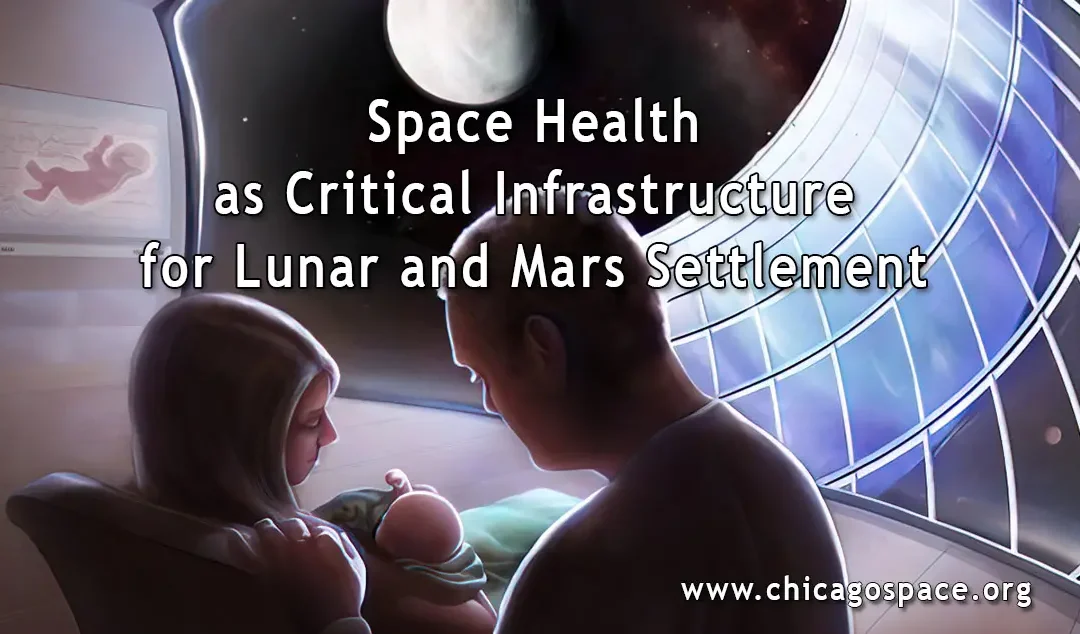
Image Credit: Pioneers of the Cosmos by Adrianna Allen, Grand Prize Winner of the National Space Society’s 2016 Space Settlement Student Art Contest
Space settlement is often framed as a problem of rockets, habitats, and resource extraction. If we can launch more cheaply, build more durable structures, and extract water or oxygen from lunar or Martian regolith, then permanent human presence beyond Earth will follow naturally. This logic is compelling, but incomplete. It treats humans as passengers in an engineered system rather than as a core subsystem that must itself be designed, maintained, and evolved.
A more accurate framing is that space settlement is not only an engineering challenge, but a human systems challenge. In particular, space health—covering medical capability, physiological adaptation, behavioural resilience, and operational medicine—functions as critical infrastructure. Without it, no amount of propulsion efficiency or in-situ resource utilization (ISRU) will translate into sustainable settlement.
The Missing Layer in Space Settlement Design
Most current lunar and Mars architectures, including those associated with NASA’s Artemis program, focus heavily on transportation systems, surface habitats, power generation, and resource utilization. These are essential components. However, they often assume that human health requirements can be addressed through incremental adaptation of current low Earth orbit (LEO) practices, such as those developed aboard the International Space Station.
This assumption is increasingly strained. LEO is not an analogue for deep space or planetary surface settlement. It benefits from rapid evacuation capability, constant resupply, and near-real-time medical consultation with Earth. Lunar and Mars environments remove or severely degrade all three conditions.
On the Moon, communication delays are short, but evacuation is still difficult and expensive. On Mars, communication delays range from 4 to 24 minutes one-way, and evacuation is effectively impossible under any realistic early settlement scenario. This transforms space medicine from a support function into a primary survival system.
Space Health as Infrastructure, Not Support
In terrestrial systems, healthcare is often treated as a service layered onto infrastructure. In space settlement, this hierarchy inverts. Health systems become part of the core infrastructure required for mission continuity.
This includes several interdependent domains:
- Medical autonomy: crews must be able to diagnose and treat a wide range of conditions without Earth-based intervention.
- Surgical capability: trauma care in microgravity or partial gravity environments must be feasible with limited resources.
- Pharmaceutical stability: medication storage, degradation under radiation, and manufacturing constraints become mission-critical issues.
- Physiological adaptation: long-duration exposure to reduced gravity affects bone density, cardiovascular function, and sensorimotor control.
- Psychological resilience: isolation, confinement, and high-stakes environments introduce cognitive and behavioural risks that directly impact mission safety.
In a settlement context, these are not ancillary concerns. They define whether a population can persist.
Lessons from the International Space Station (and Its Limits)
The International Space Station (ISS) has been an invaluable platform for understanding human spaceflight. Research conducted aboard it has expanded knowledge in bone loss mitigation, radiation exposure, fluid shifts, and behavioural health in confined environments. Organizations such as the International Space Station Research and Development Conference (ISSRDC) community and broader international collaboration frameworks have helped advance this knowledge base.
However, the ISS is fundamentally a laboratory, not a settlement analogue. Its operational model depends on continuous Earth support, including:
- rapid resupply of consumables
- regular crew rotation
- immediate emergency evacuation capability
- real-time telemedicine support
These conditions mask the full complexity of space health systems required for off-Earth settlements. A Mars base, even a small one, must assume that none of these supports are reliably available.
This distinction is crucial. It means that current biomedical knowledge in LEO is necessary but not sufficient for settlement planning.
Analog Environments and the Emergence of Integrated Human Systems
One of the most important developments in recent decades has been the rise of analogue environments and simulation-based training for space missions. These include underwater habitats, Antarctic stations, desert isolation studies, and controlled Mars mission simulations such as HI-SEAS and Mars500.
These environments reveal something important: human performance in space is not determined solely by individual resilience or engineering redundancy, but by system design. Crew composition, workload distribution, communication structures, and medical protocols all interact to produce either stability or degradation over time.
This is where interdisciplinary frameworks become essential. Programs that integrate space medicine, engineering, psychology, and operations research—such as those supported by organizations like the International Astronautical Federation and various space education and research initiatives—are increasingly pointing toward a unified model: human spaceflight systems must be designed holistically rather than as isolated subsystems.
The Mars and Lunar Reality: No External Rescue
The defining difference between ISS operations and future lunar or Martian settlements is the absence of rapid external rescue. This single constraint changes everything.
On Mars, a medical emergency cannot be resolved by evacuation. A surgical complication cannot be transferred to Earth. Even expert consultation is delayed. This creates a condition where medical self-sufficiency is equivalent to survival capability.
As a result, space health systems must be designed with assumptions that differ radically from terrestrial medicine:
- redundancy replaces specialization
- prevention outweighs intervention
- diagnostics must be compact, automated, and robust
- treatment protocols must be simplified but highly reliable
In this context, space health becomes more analogous to critical infrastructure systems such as electrical grids or water purification networks than to conventional healthcare delivery.
The Integration Problem: Why Current Architectures Fall Short
Despite recognition of these challenges, space settlement architectures often treat human health as a late-stage integration problem. Habitats are designed first; life support systems are added; medical capabilities are layered on afterward.
This sequencing is problematic. In complex systems engineering, late integration of core subsystems tends to produce fragility. Human health is not a subsystem that can be bolted onto a completed architecture—it must shape the architecture itself.
For example:
- habitat layout affects psychological stress and cognitive performance
- radiation shielding design impacts long-term cancer risk and crew rotation strategies
- exercise equipment placement and availability influences bone and muscle degradation rates
- communication delays affect decision-making protocols in medical emergencies
In other words, nearly every aspect of space settlement design has a direct or indirect health consequence.
Toward a Space Health Infrastructure Model
A more effective approach is to treat space health as an infrastructure layer co-equal with power, communications, and habitat systems. This model implies several design principles:
- Health-by-design systems engineering
Medical and physiological requirements must be embedded in early-stage habitat and mission design. - Autonomous medical capability as baseline requirement
Every settlement module must function as a semi-independent medical unit. - Continuous physiological monitoring
Real-time health data becomes part of mission control architecture, not an optional enhancement. - Integrated behavioural and environmental design
Lighting, spatial layout, and social structures must be designed for long-duration psychological stability. - Global knowledge integration
Space health will require coordinated international research frameworks, building on existing collaborations in space medicine, global health, and human performance science.
Why This Matters for Space Settlement
Space settlement is often discussed in terms of ambition: becoming a multi-planetary species, expanding human presence beyond Earth, or unlocking extraterrestrial resources. But settlement is not defined by arrival—it is defined by continuity.
Continuity requires systems that sustain human life under conditions of isolation, delay, and environmental hostility. Among all the engineering challenges in space, none is more directly tied to continuity than human health.
Without robust space health infrastructure, settlements remain dependent outposts. With it, they become self-sustaining systems capable of long-term evolution.
Conclusion
The future of space settlement will not be determined solely by propulsion breakthroughs, habitat construction techniques, or resource extraction technologies. It will be determined by whether we successfully elevate space health from a supporting function to a foundational infrastructure layer.
In this sense, the next frontier of space exploration is not just outward into the solar system, but inward into the design of human systems capable of surviving there. Space health is not a subset of space medicine—it is the operating system of space settlement itself.
Space Health References
NASA Human Research Program. (n.d.). Human research program. https://www.nasa.gov/hrp/
NASA. (n.d.). NASA. https://www.nasa.gov/
European Space Agency. (n.d.). Human spaceflight and exploration. https://www.esa.int/
International Space Station. (n.d.). International Space Station overview. https://www.nasa.gov/international-space-station/
International Space Station Research and Development Conference. (n.d.). ISS research and development conference. https://www.issconference.org/
Artemis Program. (n.d.). Artemis program. https://www.nasa.gov/artemis/
HI-SEAS. (n.d.). HI-SEAS analog mission. https://hi-seas.org/
Mars500 mission. (n.d.). Mars500 project. https://www.esa.int/Science_Exploration/Human_and_Robotic_Exploration/Mars500
National Academies of Sciences, Engineering, and Medicine. (n.d.). Reports on space and human health. https://nap.nationalacademies.org/
O’Neill, G. K. (1976). The high frontier: Human colonies in space. William Morrow.
Jessica D’Urbano works in the space sector focusing on space health, occupational medicine, and human spaceflight systems, with an emphasis on long-duration mission readiness and interdisciplinary space research. She contributes to international space education and collaboration initiatives and is engaged in space medicine, including applications informed by military and operational medicine frameworks for extreme environments.