
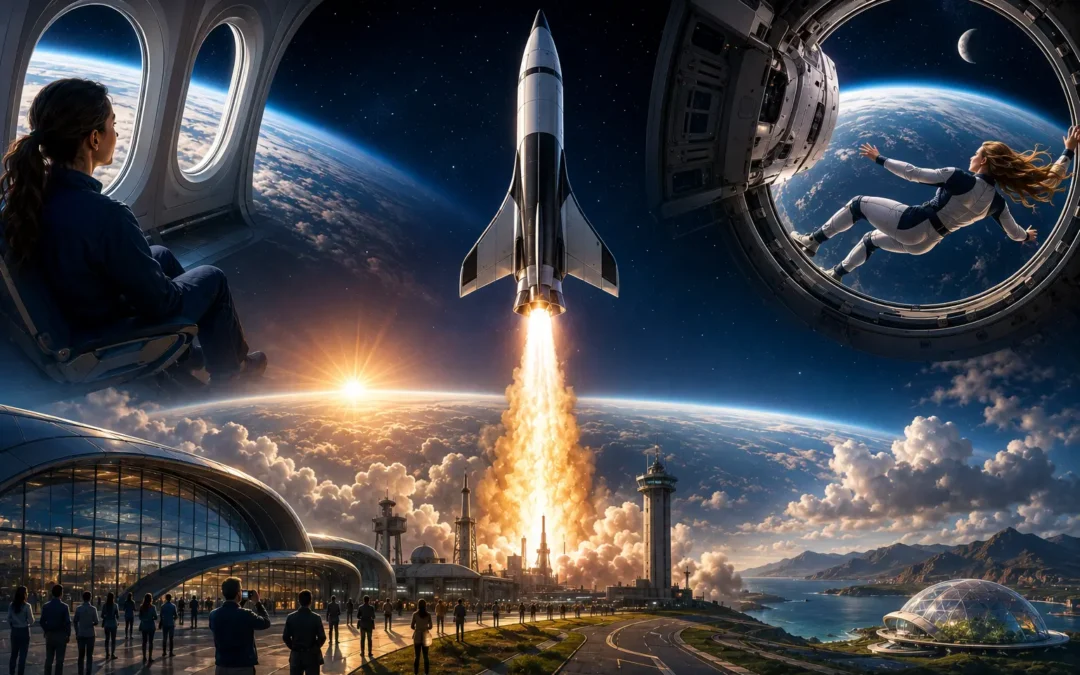
By Michael N. Daily, APR. Image Source: OpenAI ChatGPT(2026)
For generations, humanity looked toward the stars and imagined what it would be like to leave Earth behind, if only for a brief moment. Space travel existed primarily in the realm of government astronauts, science fiction, and the dreams of children staring at the night sky. Today, that dream is becoming a commercial enterprise. Space tourism is emerging as one of the most visible and fascinating sectors of the New Space economy.
The excitement surrounding space tourism, promoted by organizations such as the Space Tourism Society, is understandable. The opportunity to experience weightlessness, witness the curvature of Earth, and gain the life-changing perspective often referred to as the “overview effect” represents an experience unlike any available on our planet. What was once reserved for government astronauts is now becoming accessible to private citizens with sufficient financial resources. Companies such as Virgin Galactic, Blue Origin, and SpaceX have transformed the concept of commercial human spaceflight from speculation into reality.
The business opportunity appears substantial. Industry forecasts suggest that the space tourism market could experience extraordinary growth during the next decade. Some market analysts estimate that the sector could grow from approximately $2 billion today to tens of billions of dollars by the mid-2030s, fueled by advances in reusable launch systems, increased private investment, and growing demand for unique luxury experiences.
Yet beneath the headlines and breathtaking imagery lies a more complicated reality. The emerging space tourism business faces significant challenges that will determine whether it becomes a sustainable industry or remains a niche market serving only a small segment of ultra-high-net-worth individuals.
The most obvious challenge is affordability.
Today, a ticket to space remains one of the most expensive experiences available for purchase. Virgin Galactic recently announced pricing of approximately $750,000 per passenger for its future commercial flights, while orbital missions can cost tens of millions of dollars. Current market participation is dominated by wealthy individuals capable of spending millions for a once-in-a-lifetime experience.
History demonstrates that transportation technologies often begin as luxuries before becoming mainstream. Air travel followed this path. Commercial aviation was once reserved for the wealthy before technological innovation, competition, and operational efficiencies reduced costs. Space tourism may ultimately follow a similar trajectory, but reaching that point will require sustained technological progress, significant capital investment, and the development of compelling value propositions that justify the experience beyond its novelty.
This introduces an important branding challenge.
Many space tourism companies currently market exclusivity, prestige, and adventure. While these themes resonate with early adopters, they may ultimately limit broader market expansion. Organizations must carefully consider how their brands evolve as the industry matures. Will they remain luxury adventure providers, or will they reposition themselves as facilitators of human exploration, education, inspiration, and personal transformation? The answer will significantly influence customer acquisition strategies, investor perceptions, and long-term market growth.
Safety represents an even more critical challenge.
Spaceflight remains inherently dangerous. Every launch involves substantial technical complexity and risk. Recent incidents within the commercial launch sector serve as reminders that even with advanced technology, space remains an unforgiving environment. Public confidence in commercial human spaceflight will depend heavily upon maintaining a strong safety record as flight frequencies increase. A single high-profile accident could significantly slow market adoption and investor confidence.
From a branding perspective, trust becomes one of the industry’s most valuable assets.
Unlike many consumer products, space tourism customers are not simply purchasing a service. They are placing their lives in the hands of the provider. Consequently, brand reputation becomes inseparable from operational performance. Every launch, training experience, safety procedure, and customer interaction contributes to stakeholder perceptions. Companies that successfully establish brands associated with safety, reliability, transparency, and professionalism may enjoy significant competitive advantages as the market develops.
Closely connected to safety is the issue of regulation.
The rapid growth of commercial space activities is exposing limitations within existing legal frameworks. Much of international space law was developed during the 1960s and 1970s when governments were the primary actors in space exploration. Today’s environment includes private companies transporting paying customers beyond Earth’s atmosphere. Regulators around the world are now challenged to create policies that encourage innovation while protecting passengers, public safety, and national interests.
Regulatory uncertainty also presents branding considerations. Organizations must communicate not only technological competence but also responsible corporate citizenship. Stakeholders increasingly expect space companies to demonstrate ethical leadership, regulatory compliance, and a commitment to public interests. Brands perceived as operating ahead of or outside accepted governance frameworks may face reputational challenges regardless of their technical achievements.
Environmental concerns also continue to attract attention.
As launch activity increases, questions surrounding emissions, atmospheric impacts, and sustainability will likely become more prominent. Space tourism operators must demonstrate that growth can occur responsibly while balancing environmental stewardship with commercial objectives. This challenge mirrors broader sustainability discussions occurring throughout the transportation and aerospace industries.
For branding professionals, sustainability may emerge as a defining issue. Future customers, investors, regulators, and advocacy groups will likely scrutinize environmental claims. Organizations that proactively address sustainability concerns through transparency, innovation, and measurable environmental initiatives may strengthen stakeholder trust and differentiate themselves within an increasingly competitive marketplace.
Another challenge involves scalability.
The space tourism business has generated significant public interest, yet actual passenger numbers remain relatively small. The industry must demonstrate its ability to move beyond occasional high-profile missions and develop reliable, repeatable operations capable of serving larger customer populations. Achieving higher launch frequencies while maintaining safety, profitability, and customer satisfaction will be essential for long-term success.
Scaling operations also requires scaling brand experiences.
Many early space tourism brands have been built around founder personalities, celebrity participants, and highly publicized missions. While these approaches generate awareness, sustainable growth requires creating repeatable customer experiences that consistently reinforce brand promises. The organizations that succeed will be those capable of transforming extraordinary events into dependable, high-quality customer journeys.
Despite these obstacles, the opportunities remain compelling.
The most immediate opportunity lies in technological innovation. Reusable launch systems have already transformed the economics of space access. Continued advances in propulsion systems, spacecraft design, manufacturing techniques, and operational efficiency could dramatically reduce costs over time. The same innovation that has reshaped satellite launches may eventually reshape human spaceflight.
The industry also creates opportunities far beyond tourism itself.
Space tourism serves as a catalyst for broader commercial space development. Human-rated spacecraft, spaceports, training facilities, life-support technologies, and in-space infrastructure all benefit from investments driven by tourism demand. In many respects, space tourism acts as an economic bridge that helps finance technologies and capabilities that may ultimately support commercial space stations, lunar activities, and future exploration initiatives.
There is also a powerful branding opportunity.
Few industries capture public imagination as effectively as space. Companies involved in space tourism enjoy extraordinary visibility and media attention. Every successful mission generates global coverage, reinforcing public interest and attracting investors, partners, and future customers. For many organizations, participation in the space tourism ecosystem extends beyond revenue generation and contributes to broader brand positioning within the rapidly expanding space economy.
The most successful brands may ultimately be those that transcend tourism altogether.
Rather than merely selling rides, they may position themselves as enabling humanity’s next chapter. The strongest brands in the emerging space economy will likely connect their missions to larger narratives involving exploration, innovation, education, sustainability, scientific advancement, and humanity’s long-term future beyond Earth. These narratives create emotional connections that extend far beyond individual transactions.
Community building presents another significant opportunity.
Space tourism customers often become passionate advocates, sharing experiences through media appearances, social platforms, educational outreach, and public speaking engagements. Organizations that cultivate strong brand communities can transform customers into ambassadors who amplify awareness, credibility, and enthusiasm. Such communities may become powerful strategic assets that support long-term growth and stakeholder engagement.
Perhaps the greatest opportunity, however, is cultural rather than commercial.
Throughout history, transportation innovations have expanded humanity’s horizons. Ships connected continents. Railroads transformed nations. Aviation connected the world. Space tourism represents the earliest stage of humanity’s transition toward becoming a spacefaring civilization. While today’s passengers are primarily wealthy adventurers, tomorrow’s travelers may include researchers, educators, entrepreneurs, and eventually ordinary citizens.
The emerging space tourism industry stands at a crossroads between dream and reality. Its future will be shaped by its ability to address safety concerns, reduce costs, navigate regulatory complexities, manage environmental responsibilities, build trusted brands, and demonstrate sustainable business models. Success is far from guaranteed.
Yet the same could have been said about commercial aviation in its earliest years.
The companies building today’s space tourism market are not simply selling tickets. They are building trust, shaping public perceptions, creating new categories of customer experience, and establishing the foundations of an entirely new industry. Whether that industry ultimately serves thousands, millions, or future generations living and working beyond Earth remains to be seen.
What is clear is that humanity’s desire to explore has never diminished. Space tourism may be the first commercial expression of that timeless impulse. The challenge now is transforming extraordinary experiences for a few into sustainable opportunities for many.
In the process, the industry’s greatest competitive advantage may not be its rockets, spacecraft, or launch facilities. It may be its ability to build brands that inspire people to believe that humanity’s future extends far beyond the horizon of Earth itself.
Michael N. Daily, APR, is a veteran brand strategist, communications executive, and retired U.S. Marine Corps Colonel with more than 36 years of experience in strategic communications, public relations, and branding. He specializes in helping organizations build strong brands, engaged stakeholder communities, and sustainable growth, with a particular focus on the commercial space industry. As founder of Newspace Brand Builders, he helps space companies transform technical excellence into market leadership.